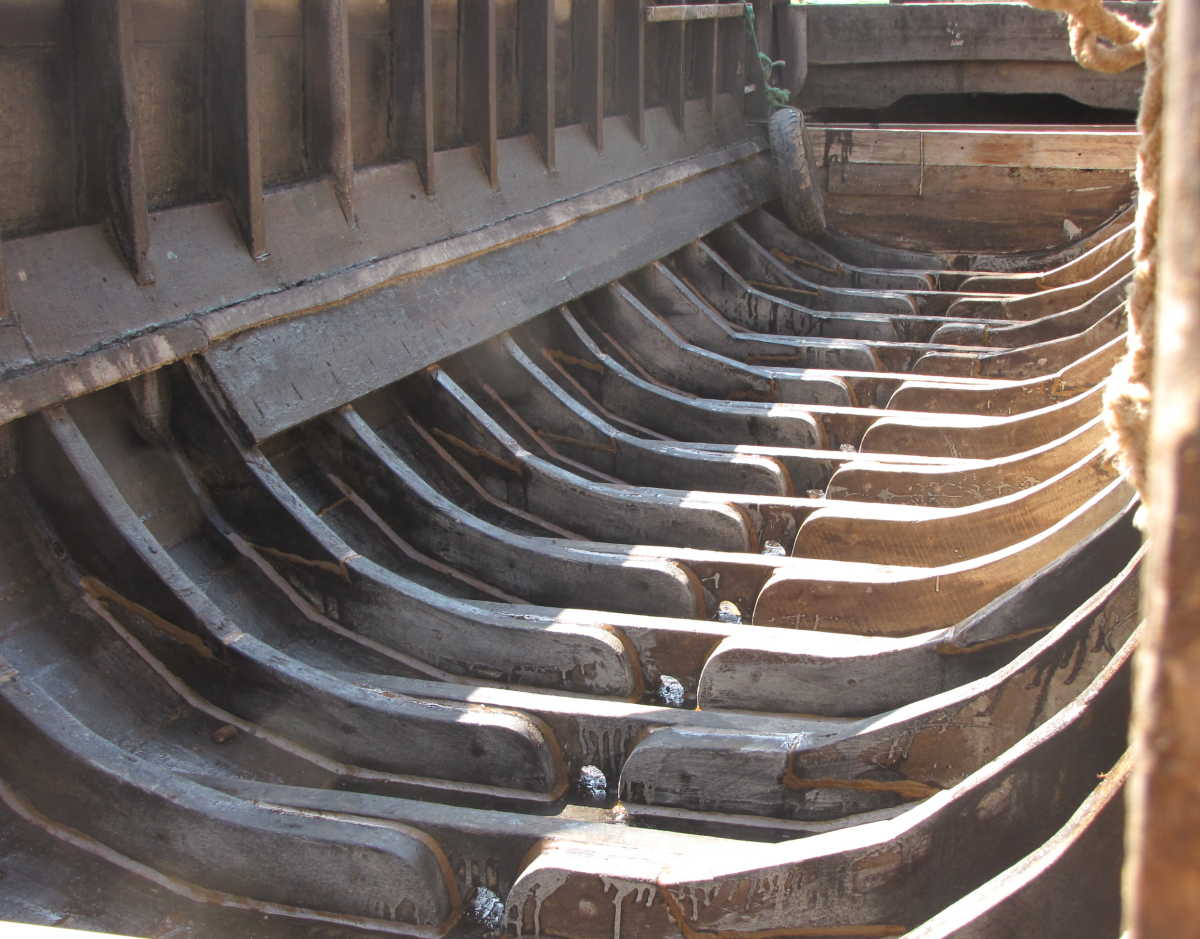
Carvel Planking
Carvel planking is the oldest and most widely recognised method for building wooden hulls. Planks are laid side by side rather than overlapping, each one shaped individually to follow the curve of the frame. The outer faces of adjacent planks meet flush, producing a smooth hull surface. Once the planks are in place, a slight bevel along each outer edge is packed with cotton caulking to seal the seam against water.
Because each plank is fitted and caulked individually, a carvel hull can be repaired plank by plank without disturbing the rest of the hull. This is one reason the method remained standard in commercial fishing and working-boat construction well into the twentieth century. Atlantic Canada's schooner fleets — including the original Bluenose and dozens of similar vessels built at Lunenburg — were carvel-planked.
The main drawback is the time required. Spiling (transferring the shape of each plank to the next piece of timber) and fitting the bevels demands experience and patience. A well-built carvel hull is also heavier than a comparable lapstrake or strip-plank hull, though the weight distribution can be an advantage in a working vessel expected to carry load and withstand rough water.
In Nova Scotia, carvel construction was the standard at yards like Smith & Rhuland throughout the Grand Banks fishing era. It declined in commercial use as fibreglass became available in the 1950s and 1960s, but it has continued in restoration work. Several vessels at the Lunenburg waterfront are maintained using original carvel methods, and the Maritime Museum of the Atlantic in Halifax holds documentation of the technique as it was practised in the region.
Lapstrake Construction
In lapstrake (or clinker) construction, each plank overlaps the edge of the one below it. Fasteners are driven through the overlapping section, called the lap, holding the planks together along their length. This produces a hull with horizontal ridges running its length — the distinctive appearance most associated with small pulling and sailing craft.
The overlapping structure gives lapstrake hulls a high degree of rigidity without requiring a heavy internal frame. The planks themselves carry much of the structural load. This makes lapstrake well-suited to small, lightweight boats — dories, skiffs, rowing tenders — where weight matters and the hull is not expected to carry substantial cargo.
In Atlantic Canada, lapstrake dory construction was standard in the fishing communities of Nova Scotia and Newfoundland. The Lunenburg Dory Shop uses a version of lapstrake construction that has not changed significantly in over a century. For boats up to approximately 15 feet, builders typically use 9 to 11 planks per side, with each plank's width kept between 3.5 and 5 inches amidships. The proportions produce a hull that rows efficiently and handles breaking seas with the bow-high stance typical of the Grand Banks dory.
Lapstrake has also been used in New Brunswick. Builders in Letete have worked in the tradition for generations, using local spruce and cedar. The method requires less material than carvel because the overlapping planks eliminate the need for caulking — the laps are bedded in compound and fastened tight, creating a mechanical seal.
Cedar Strip Epoxy Construction
Cedar strip epoxy construction — usually called strip planking — is a more recent method, though it draws on earlier strip-laid hull techniques. Narrow cedar strips, typically 3/4 inch wide and uniform in thickness, are glued edge-to-edge over a series of temporary moulds to form the hull shape. Once the strips have been glued and the hull is faired, the entire surface is sheathed in fibreglass cloth set in epoxy resin — inside and outside. The result is a wood-core composite structure with high strength-to-weight ratio and no caulking seams.
The method is particularly common in British Columbia, where western red cedar is readily available and has a long association with canoe building, both in Indigenous tradition and in recreational boatbuilding. The Cowichan Bay Maritime Centre on Vancouver Island has documented cedar strip construction in its workshop programme since the 1980s. The Pender Harbour Living Heritage Society and similar groups in the BC interior have offered cedar strip canoe builds as part of heritage education since at least the mid-2000s.
Compared to carvel or lapstrake, strip planking requires fewer specialised tools and is more accessible to builders without formal training. The temporary moulds are cut from plywood and need not be preserved after the hull is built. The hull's shape comes entirely from the mould stations rather than from the builder's eye, which reduces the margin for error on critical dimensions. This has made it the method of choice for community build projects, school programmes, and first-time builders working from published plans.
The trade-off is material cost — epoxy resin and fibreglass cloth add to the budget — and the need for careful surface preparation before the cloth is applied. A strip plank hull that is not faired properly before lamination will lock in high spots that cannot be removed once the epoxy cures.
Choosing Between the Methods
Each method remains in active use in Canada for reasons specific to the type of boat, the builder's background, and the intended use.
- Carvel is most likely to appear in restoration work on heritage vessels, and in new construction of larger traditional designs where smooth hull lines and repairability are priorities.
- Lapstrake remains the standard for traditional dory production and is used in new builds of small pulling craft and sailing tenders where lightness and rigidity in a small hull are valued.
- Cedar strip epoxy is the dominant choice for recreational canoes, kayaks, and small day-sailing craft, particularly in BC, Ontario, and wherever western red cedar is available and epoxy supplies are accessible.
All three methods produce wooden hulls that, if built and maintained properly, last several decades. The Dory Shop in Lunenburg regularly repairs and rebuilds dories that are 30 and 40 years old. Cedar strip canoes built in the 1970s and 1980s are still paddled on lakes across Canada. The longevity of these hulls is largely a function of how well they are stored out of the water and how often the finish is renewed.
External References
- The Dory Shop, Lunenburg — doryshop.com
- Cowichan Bay Maritime Centre — classicboats.org
- WoodenBoat School, Planking Guides — skills.woodenboat.com
Last updated: May 4, 2026